



Contact


Reuse
The return rate drives productivity
Manufacture once, reuse as often as possible — this is how reusable packaging creates value. Manufacturing costs are incurred only once; after that, only collection and servicing costs remain. For this reason, the return rate is crucial not only environmentally, but also economically: the higher the return rate, the more cost-effective the packaging becomes.

Design for reuse
The design of reusable packaging is not an isolated design or product decision. It must take into account the physical, operational and economic conditions for use as well as across the entire reuse system.
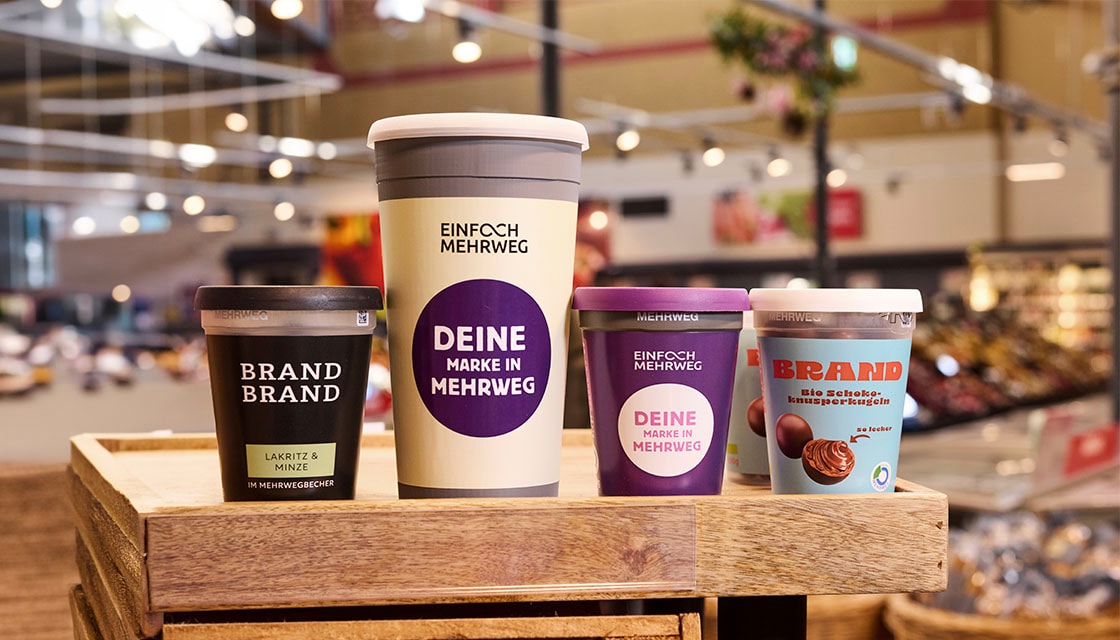
Coffee cups must work both for coffee and for the system; food packaging must work for filling, logistics, selling, the relevant food category and for the system at large. The choice of material, form factor, durability, standardisation and placement of codes determine how easily packaging can be returned, maintained and managed within the system.

Packaging requirements for system design at large
COLLECT – Return Network
Packaging design defines how easily packaging can be recognised, returned and collected. Standardisation, robustness and clear identification are prerequisites for high return rates and convenient collection processes.
If packaging does not meet these requirements, return barriers increase — and with them system costs and losses.
SERVICE – Pool Care
Packaging design determines sorting effort, cleanability and pool lifespan. Complex materials, poorly separable components or low durability increase service costs and shorten the usage cycle.
Packaging design thus directly determines the economic viability of service operations.
MANAGE – Pool Management
Packaging design determines how well packaging can be captured, tracked and managed within the system. Clear identification and cycle stability are prerequisites for reliable inventory management, billing and partner coordination.
Without packaging design capable to be managed, system control becomes fragmented or manual.
Systemic context
These requirements demonstrate why the design of reusable packaging cannot be optimized for reuse without taking into account all value streams from our operating model—Collect, Service, Manage, and Reuse.

Continue to the value spaces



Contact
Reuse
The return rate drives productivity
Manufacture once, reuse as often as possible — this is how reusable packaging creates value. Manufacturing costs are incurred only once; after that, only collection and servicing costs remain. For this reason, the return rate is crucial not only environmentally, but also economically: the higher the return rate, the more cost-effective the packaging becomes.
Design for reuse
The design of reusable packaging is not an isolated design or product decision. It must take into account the physical, operational and economic conditions for use as well as across the entire reuse system.
Coffee cups must work both for coffee and for the system; food packaging must work for filling, logistics, selling, the relevant food category and for the system at large. The choice of material, form factor, durability, standardisation and placement of codes determine how easily packaging can be returned, maintained and managed within the system.

Packaging requirements for system design at large
COLLECT – Return Network
Packaging design defines how easily packaging can be recognised, returned and collected. Standardisation, robustness and clear identification are prerequisites for high return rates and convenient collection processes.
If packaging does not meet these requirements, return barriers increase — and with them system costs and losses.
SERVICE – Pool Care
Packaging design determines sorting effort, cleanability and pool lifespan. Complex materials, poorly separable components or low durability increase service costs and shorten the usage cycle.
Packaging design thus directly determines the economic viability of service operations.
MANAGE – Pool Management
Packaging design determines how well packaging can be captured, tracked and managed within the system. Clear identification and cycle stability are prerequisites for reliable inventory management, billing and partner coordination.
Without packaging design capable to be managed, system control becomes fragmented or manual.
Systemic context
These requirements demonstrate why the design of reusable packaging cannot be optimized for reuse without taking into account all value streams from our operating model—Collect, Service, Manage, and Reuse.

Continue to the value spaces


EN
Contact

Reuse
The return rate drives productivity
Manufacture once, reuse as often as possible — this is how reusable packaging creates value. Manufacturing costs are incurred only once; after that, only collection and servicing costs remain. For this reason, the return rate is crucial not only environmentally, but also economically: the higher the return rate, the more cost-effective the packaging becomes.
Design for reuse
The design of reusable packaging is not an isolated design or product decision. It must take into account the physical, operational and economic conditions for use as well as across the entire reuse system.
Coffee cups must work both for coffee and for the system; food packaging must work for filling, logistics, selling, the relevant food category and for the system at large. The choice of material, form factor, durability, standardisation and placement of codes determine how easily packaging can be returned, maintained and managed within the system.

Packaging requirements for system design at large
COLLECT – Return Network
Packaging design defines how easily packaging can be recognised, returned and collected. Standardisation, robustness and clear identification are prerequisites for high return rates and convenient collection processes.
If packaging does not meet these requirements, return barriers increase — and with them system costs and losses.
SERVICE – Pool Care
Packaging design determines sorting effort, cleanability and pool lifespan. Complex materials, poorly separable components or low durability increase service costs and shorten the usage cycle.
Packaging design thus directly determines the economic viability of service operations.
MANAGE – Pool Management
Packaging design determines how well packaging can be captured, tracked and managed within the system. Clear identification and cycle stability are prerequisites for reliable inventory management, billing and partner coordination.
Without packaging design capable to be managed, system control becomes fragmented or manual.
Systemic context
These requirements demonstrate why the design of reusable packaging cannot be optimized for reuse without taking into account all value streams from our operating model—Collect, Service, Manage, and Reuse.

Continue to the value spaces
EN
Contact

Reuse
The return rate drives productivity
Manufacture once, reuse as often as possible — this is how reusable packaging creates value. Manufacturing costs are incurred only once; after that, only collection and servicing costs remain. For this reason, the return rate is crucial not only environmentally, but also economically: the higher the return rate, the more cost-effective the packaging becomes.
Design for reuse
The design of reusable packaging is not an isolated design or product decision. It must take into account the physical, operational and economic conditions for use as well as across the entire reuse system.
Coffee cups must work both for coffee and for the system; food packaging must work for filling, logistics, selling, the relevant food category and for the system at large. The choice of material, form factor, durability, standardisation and placement of codes determine how easily packaging can be returned, maintained and managed within the system.

Packaging requirements for system design at large
COLLECT – Return Network
Packaging design defines how easily packaging can be recognised, returned and collected. Standardisation, robustness and clear identification are prerequisites for high return rates and convenient collection processes.
If packaging does not meet these requirements, return barriers increase — and with them system costs and losses.
SERVICE – Pool Care
Packaging design determines sorting effort, cleanability and pool lifespan. Complex materials, poorly separable components or low durability increase service costs and shorten the usage cycle.
Packaging design thus directly determines the economic viability of service operations.
MANAGE – Pool Management
Packaging design determines how well packaging can be captured, tracked and managed within the system. Clear identification and cycle stability are prerequisites for reliable inventory management, billing and partner coordination.
Without packaging design capable to be managed, system control becomes fragmented or manual.
Systemic context
These requirements demonstrate why the design of reusable packaging cannot be optimized for reuse without taking into account all value streams from our operating model—Collect, Service, Manage, and Reuse.
